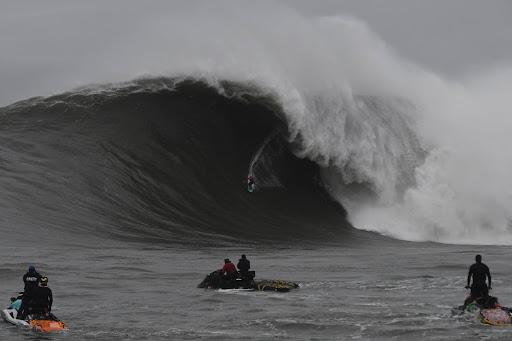
Introduction: A Hidden Epidemic Beneath the Waves
Each winter, as Pacific storms send massive swells toward Half Moon Bay, California, an elite group of surfers and rescue professionals converge for the Mavericks Ocean Safety Summit. This annual interagency training event unites Coastside Fire / CAL FIRE, U.S. Coast Guard (Golden Gate and Air Station San Francisco), San Mateo County Park Rangers, State and National Parks Lifeguards, and local EMS to refine high-risk ocean rescue operations at one of the world’s most formidable surf breaks.
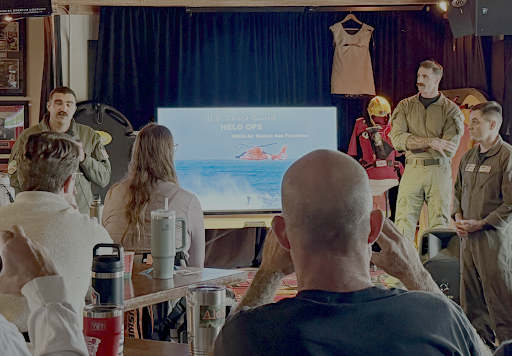
U.S. Coast Guard training at the Mavericks Safety Summit. (Audrey Lambidakis)
In 2025, I was invited to present on behalf of Healing Brainwaves, a nonprofit dedicated to awareness and recovery after brain injury. My session—Head Injury Recognition, Recovery, and Mental Health in Big Wave Surfing—addressed a neglected but pressing issue in extreme sports: the high prevalence of undiagnosed concussions and the mental health toll following surf-related head trauma.
What began as a technical ocean safety training evolved into a dialogue about long-term neurological well-being, transforming the summit into a grassroots public health initiative at the intersection of wilderness medicine and ocean rescue.
The Summit: A Wilderness Medicine Environment
The Mavericks Safety Summit exemplifies wilderness medicine in an aquatic domain. Environmental exposure, logistical isolation, and unpredictable hazards make the site a natural analog to expedition or remote trauma care. Rescuers face cold-water immersion, hypoxia, high-velocity impacts, and complex extrications—often without immediate access to advanced diagnostics or definitive care.
Within this context, brain injury management presents unique challenges. Concussed surfers may mistake disorientation for fatigue or dismiss persistent headaches as part of the sport’s intensity. With limited medical infrastructure on-site, recognition and peer intervention become the most effective tools available.
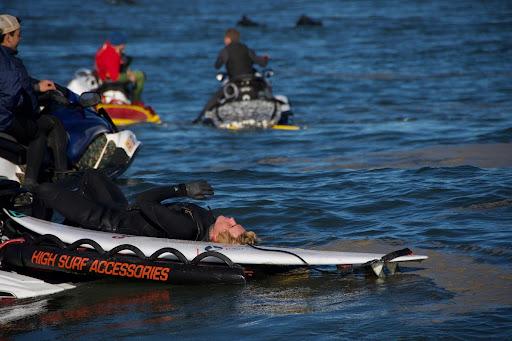
Surfer after severe wipeout. (Audrey Lambidakis)
The Presentation: Recognition, Recovery, and Resilience
Following presentations from meteorologists, Coast Guard officers, and EMS educators, our session closed out the first day of the summit. I spoke alongside Audrey Lambidakis, founder of Healing Brainwaves, to an audience of firefighters, lifeguards, water patrol veterans, and elite athletes—many with personal histories of injury.
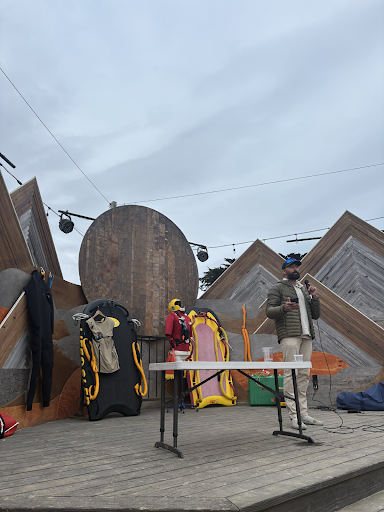
Presentation on head injury recognition and mental health awareness, 2025 Summit. (Audrey Lambidakis)
Our objectives were threefold:
- Recognize acute red flags for concussion and intracranial injury in the field.
- Initiate appropriate next steps, including rest, medical evaluation, and mental health follow-up.
- Normalize dialogue about recovery and emotional well-being after head injury.
Attendees received the educational pamphlet “Mavericks Head Injury & Mental Health Awareness,” developed by Healing Brainwaves in collaboration with researchers at UCLA. The handout summarized concussion red flags, local emergency and behavioral health resources, and carried a simple message:
“The waves will always be there. Protect your brain first.”
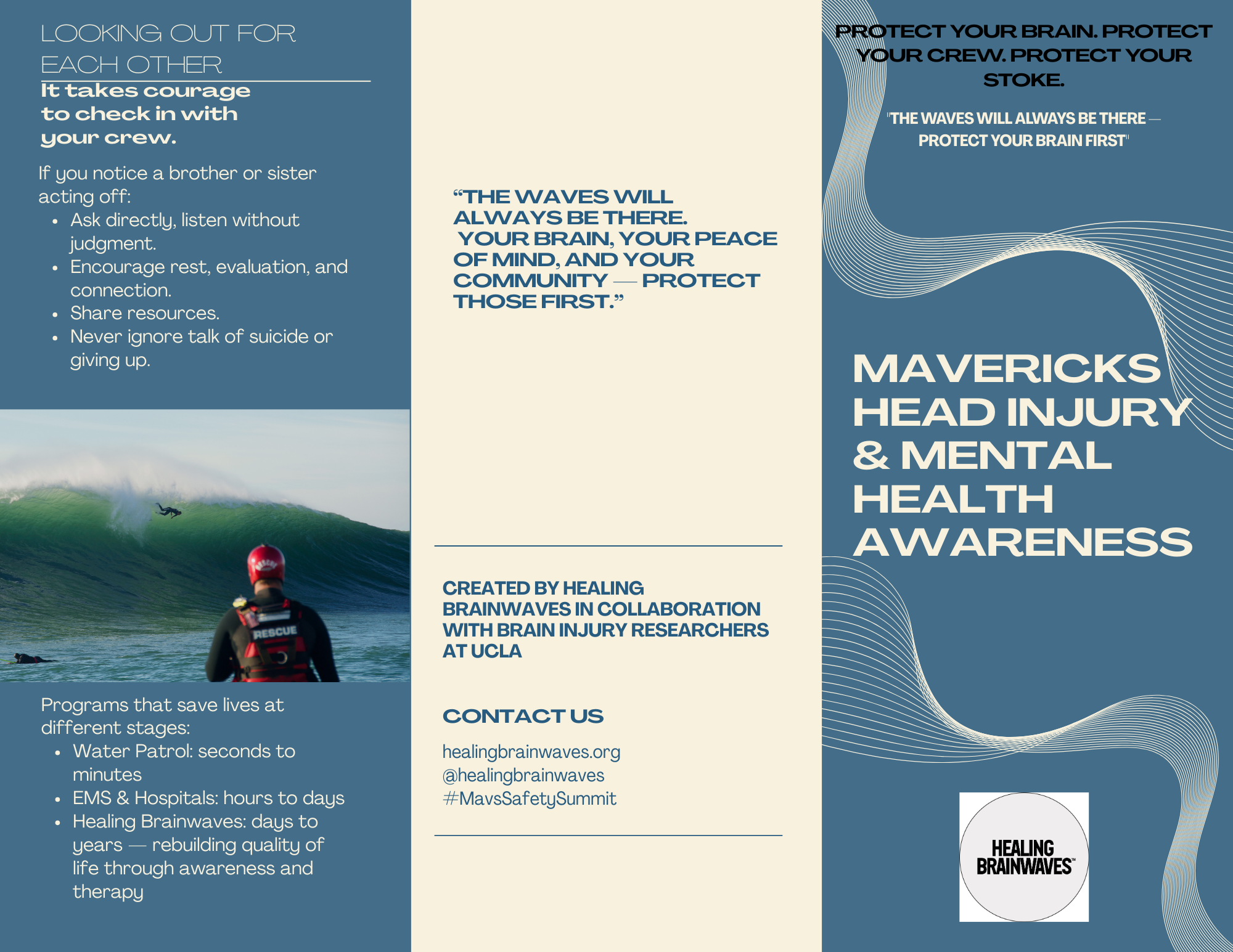
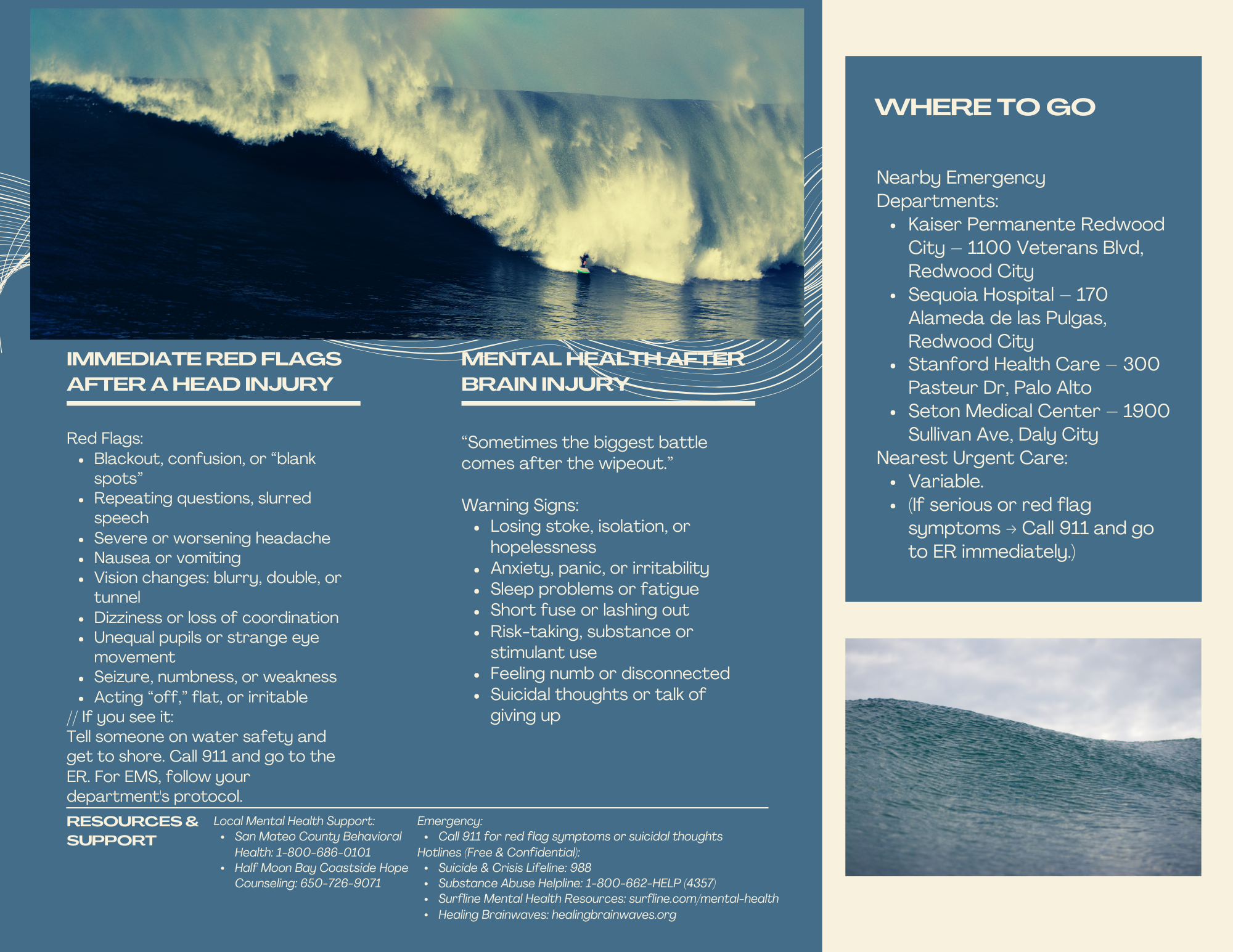
Educational pamphlet “Mavericks Head Injury & Mental Health Awareness,” distributed to participants. (Audrey Lambidakis)
Despite being the final presentation of a full day, the response was profound. Many first responders and watermen shared that they had long experienced cognitive or emotional symptoms without recognizing their significance. Several thanked us for “putting words to something we’ve all felt but never talked about.”
Head Injury in Big Wave Surfing: An Emerging Wilderness Concern
Big wave surfing is not merely an extreme sport—it is a wilderness environment governed by nature’s volatility. The medical risks mirror other high-exposure fields: repetitive mild traumatic brain injury (mTBI), near-drowning hypoxia, and post-concussive psychiatric sequelae.
Surfers often operate far from definitive care, with water safety teams as the first and sometimes only responders. Traditional trauma protocols rarely address cognitive assessment in the field, yet the combination of impact forces, oxygen deprivation, and environmental stressors can result in complex neurotrauma.
Unlike professional contact sports, there is no athletic trainer, team physician, or mandated recovery period. Without structured awareness, many return to the water prematurely risking cumulative neurological damage. The surf zone thus represents a frontier for wilderness-based concussion education.
Cultural Barriers and Behavioral Health
One of the strongest themes to emerge from post-lecture discussions was cultural. Within the big wave community, a spirit of stoicism and self-reliance often discourages vulnerability. Many athletes described years of coping with insomnia, anxiety, or irritability—symptoms consistent with post-concussive syndrome—without ever seeking help.
By framing mental health recovery as a continuation of physical injury management rather than a separate issue, we found the message resonated. The campaign’s language emphasized crew responsibility, with slogans such as “Protect Your Brain. Protect Your Crew. Protect Your Stoke.” Awareness became a shared safety value rather than an individual weakness.
A Model for Wilderness Public Health
The Mavericks program illustrates how community-driven education can extend wilderness medicine beyond remote clinics and into the cultural spaces where risk is normalized. Similar frameworks could be adapted for mountain guiding, backcountry skiing, or river rescue—settings where concussions are common yet underreported.
Such educational and outreach initiatives are cost-effective, low-tech, and highly translatable: posters, checklists, and peer scripts can shift awareness more efficiently than medical equipment alone. The partnership between grassroots rescuers and academic institutions demonstrates a replicable model for other wilderness communities facing high-risk exposure.
Conclusion: Protecting the Stoke
The Mavericks Safety Summit stands as an example of how wilderness and emergency medicine can merge with public health outreach to foster resilience within specialized communities.
Bringing brain injury and mental health awareness to the big wave surf community is more than a prevention strategy—it is an act of cultural preservation. When we protect the brain, we preserve the stoke, the spirit, and the community that defines the ocean’s frontier.
Acknowledgments:
The author would like to acknowledge Frank Quiarte and Drake Stanley, and the entire Mavericks Water Safety crew who created the Mavericks Safety Summit, as well as, pioneer and maintain the global gold standard for big wave water safety.
The authors would like to acknowledge ChatGPT for use in grammar and phrasing refinement. All intellectual content, data interpretation, and conclusions are solely the work of the authors.