Dr. Ryan Eggers is an orthopedic trauma surgeon practicing in St. George, Utah, with extensive experience in wilderness medicine. An accomplished outdoorsman and ultrarunner, his achievements include completing the Tahoe Rim Trail 100 Miler and setting a record unsupported time on the Georgia Appalachian Trail. Dr. Eggers has been involved with the Wilderness Medical Society since medical school and has served as faculty for the two-week Virginia resident elective.
At the 2026 WMS Winter Conference, Dr. Eggers will share his expertise on the intersection of orthopedic trauma and backcountry care in his talk “Orthopedic Trauma Head to Toe” and workshop “Reduction and Stabilization Techniques for Wilderness Orthopedic Injuries.”
Ahead of the conference, WMS Conference Ambassador Celine Bennett interviewed Dr. Eggers about adapting orthopedic care for wilderness environments, injury prevention as an ultrarunner, the contents of his emergency kit, and more.
CB: Orthopedic trauma care often requires a high resource environment - how do you adjust to providing care in the wilderness setting when you may not have all the resources you need?
RE: The vast majority of my training and experience is in the resource-rich hospital settings with access to radiography and great pain control. My philosophy on wilderness orthopedics is pretty simple: anything is better than nothing and know the big dangerous things. As a surgeon, I can fix a lot of really bad problems with a few notable exceptions. Fortunately, those exceptions are exceedingly rare (compartment syndrome, dysvascular limb, etc.). Most wilderness orthopedic trauma will need intervention sometime later, and there’s a timeframe of days to weeks to intervene without a significant impact on outcomes. There isn’t much of a role for achieving perfection in the field.
CB: How have your experiences in wilderness medicine shaped your care when in a more traditional healthcare setting?
RE: My wilderness medicine experience has made me appreciate the little things I would otherwise take for granted in the hospital, like x-rays for diagnosis. I attended my first wilderness medicine conference in medical school, before going into orthopedic surgery. Since then, I’ve tried to hone my physical diagnosis skills and reduction and splinting with the goal of being able to implement them in a setting without the x-rays for diagnosis or pain control for reductions or adequate splinting material. That is, in patient interactions I think “what would this look like in the wild? Could I do this?” I try to practice visualizing the fracture based on the limb appearance prior to seeing the x-ray. Accurate physical diagnosis is critical in the wilderness environment.
CB: Orthopedic surgery is a very demanding specialty, how do you make time to pursue your outdoor interests and wilderness medicine?
RE: I don’t spend nearly as much time outdoors as I would like. But I was very intentional about choosing to live and work in a location (southern Utah) that is in close proximity to a wide variety of outdoor recreation and where my colleagues and the community at large places a high value on those activities. It’s easy to go drop a beautiful canyoneering route and be home by dinner, so I only need one day off rather than several. Most of my coworkers — from OR staff to surgeon partners — regularly participate in some form of outdoor recreation.
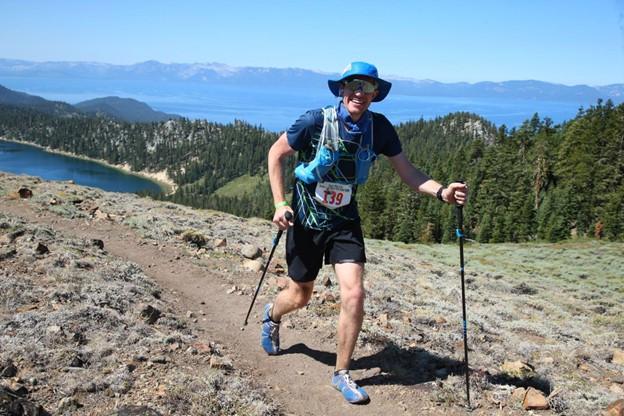
Dr. Eggers competing at the Tahoe Rim Trail 100 Miler.
CB: Based on your experience as an accomplished ultrarunner and orthopedic surgeon, what are the most common overuse injuries in ultrarunning, and what concrete steps can athletes take in training and racing to prevent them?
RE: How much time do you have? One benefit of ultrarunning is that speed is not a primary focus for most, so tissue strain is not quite as high on a shorter timeframe. That being said, training volume — i.e. time-on-feet — can be significantly more than other sports and shorter distance running. The knees are particularly prone to overuse injuries, though often as a downstream effect of another body part. For example, many people spend so much time sitting that the hips are tight in the front and can’t extend as they should for propulsion, which puts more strain on the anterior knee and increases the impact force through the joints, rather than allowing it to distribute through tendon and fascial elasticity. I’m a huge advocate for proper running form from foot strength and mobility to upper body positioning. I think that’s the best way to make running a healthy, long-term activity.
CB: What advice do you have for medical students and residents hoping to build a career in wilderness medicine?
RE: Half of life is just showing up. Go to conferences. Talk with people. Attend the electives. Accept invitations. Also remember that this is a long-term career: you don’t have to accomplish everything before you graduate. Start with relationships and the experiences will build over the years. It’s also easier to afford all of the CME vacations when you’re done with training. Also remember that just like the body has many parts and no one part does it all, we all have different experiences and talents and expertise. So don’t expect to be the expert on everything — but learn from the experts that are all eager to share what they know.
CB: From a wilderness medicine perspective, what advances in the assessment and management of orthopedic trauma would most improve patient outcomes in remote or resource-limited environments?
RE: A small, portable x-ray similar to point-of-care ultrasound and safe, effective analgesia for in-field reductions.
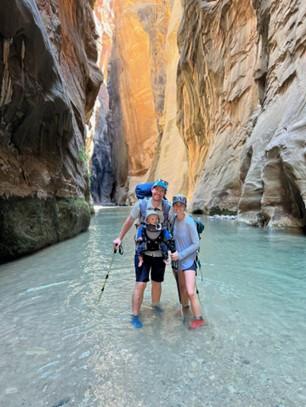
Dr. Eggers with his family adventuring.
CB: What is in your emergency kit when you go on a backcountry trip with your family?
RE: I have small kids right now so I’m not packing fast and light. I bring a lot. SAM splint, gauze, wound closure strips, band aids of every size, ibuprofen, acetaminophen, moleskin, Dermabond, quick clot, iodine swab sticks, alcohol pads, chest seal, 14 gauge angiocatheter for needle thoracotomy, tiny bandage scissors, Esmarch bandage, duct tape, KT tape strips, Neosporin, and a tampon— for nosebleeds. All of that goes in a waterproof zip pouch. Then I usually have a paracord-wrapped emergency blanket, fire starter with tinder, storm whistle, emergency headlamp, and my Garmin InReach. I’m sure I’m forgetting something. I’m not a minimalist.
CB: As an orthopedic trauma surgeon, what do you see as your role in a patient’s recovery from traumatic orthopedic injury?
RE: My role for my patients is to maximize their long-term function. Sometimes that means life over limb. Occasionally it means return to prior high-level function (professional athletes, etc.), i.e. achieving perfection. My role is also to avoid, mitigate, and treat sequelae like infection, post-traumatic arthritis, nonunion, atrophy, etc. Once I lay hands on a patient, I see them for the next several months to several years. It’s a long-term approach, which is both the challenge and the reward.