Introduction
Scientific diving is a misunderstood branch of SCUBA diving. Recreational divers descend for personal challenge or enjoyment. Commercial divers perform underwater construction and inspection as part of industrial contracts. Technical divers explore complex or extreme environments using advanced equipment.
The purpose of scientific diving, as defined by AAUS, is the collection of data for research or education. These dives are non-commercial and cannot support industrial or profit-driven tasks, even when the divers are salaried employees of universities, government agencies, or non-profit organizations. Each dive is planned, documented, and carried out under institutional standards that protect both diver safety and research validity.
Historical Context and Institutional Framework
Scientific diving as a distinct discipline developed from legal and logistical needs in the United States during the 1970s. The Occupational Safety and Health Administration (OSHA) established commercial diving regulations under 29 CFR 1910 Subpart T, requiring surface-supplied systems, support crews, and heavy industrial equipment. These measures suited pipeline repair or construction but were impossible to apply to small research teams using scuba.
Universities and federal agencies petitioned for a separate category that reflected the scientific nature of their work. In 1983, OSHA recognized scientific diving as a non-industrial activity and granted an exemption to organizations that met AAUS standards. Each institution was required to maintain a Diving Control Board, a Diving Safety Officer, and written manuals covering training, emergency procedures, and record keeping.
This model soon became the international standard. The Canadian Association for Underwater Science (CAUS), the European Scientific Diving Panel (ESDP), and the Confédération Mondiale des Activités Subaquatiques (CMAS) adopted similar systems.
The National Oceanic and Atmospheric Administration (NOAA) implemented equivalent requirements for its federal operations and today trains more than 2,000 active scientific divers each year. Data from AAUS and NOAA show that research diving consistently maintains one of the lowest injury rates among professional diving activities.
Training, Certification, and Continuing Competence
Scientific diving requires structured training and continuous verification. AAUS mandates at least 100 hours of instruction in diving science, sampling techniques, and essential first aid and rescue skills. Ongoing authorization depends on annual medical clearance, minimum dive activity, and periodic skills assessment overseen by each institution’s Diving Control Board.
International systems such as CMAS, the ESDP framework, and CAUS follow similar competency-based models. Unlike recreational or technical certifications, which remain valid once issued, scientific diving requires active participation and regular review to ensure divers remain fit, capable, and reliable in research settings.
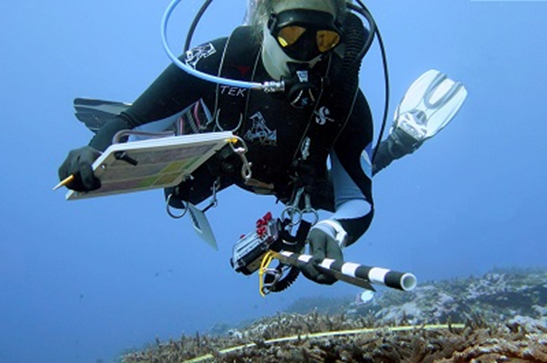
NOAA scientific diver conducting a coral transect survey using a measuring tape and slate (NOAA Diving Program, 2023).
Operational Planning and Safety Management
Every research dive is governed by a written plan. The NOAA Diving Program and AAUS both require detailed documentation and pre-dive briefings that define scientific objectives, environmental conditions, and contingency measures.
Typical briefings cover five elements:
- Research objectives and expected outcomes.
- Environmental review of depth, current, visibility, and hazards.
- Role assignments and confirmation of equipment readiness.
- Gas management and decompression planning.
- Emergency protocols and evacuation routes.
Safety and research validity are inseparable. Any method that cannot be performed safely is redesigned, and any procedure that compromises data quality is corrected before approval. AAUS and NOAA require at least two qualified divers per operation, each capable of performing the other’s tasks. This redundancy supports both data integrity and diver safety. Surface teams monitor conditions, track dive times, and manage communication, and in remote areas may include medical personnel trained in diving medicine.
Ethical Responsibility and Environmental Stewardship
Ethics are central to scientific diving. Divers are trained to limit contact with marine life, avoid disturbing sediments, and protect sensitive environments. AAUS, CMAS, and the ESDP identify environmental awareness as a professional duty. Accuracy and reproducibility carry the same weight, because poor sampling or incomplete documentation can compromise research. Institutions therefore require systematic recording of site data, sample labels, and photographic references.
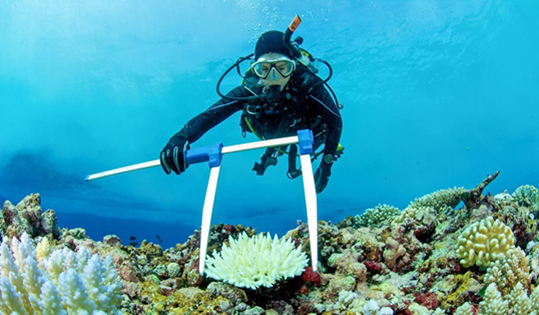
A scientific diver measures a reef segment for coral density (Divers Alert Network, 2012).
Comparing Diving Types
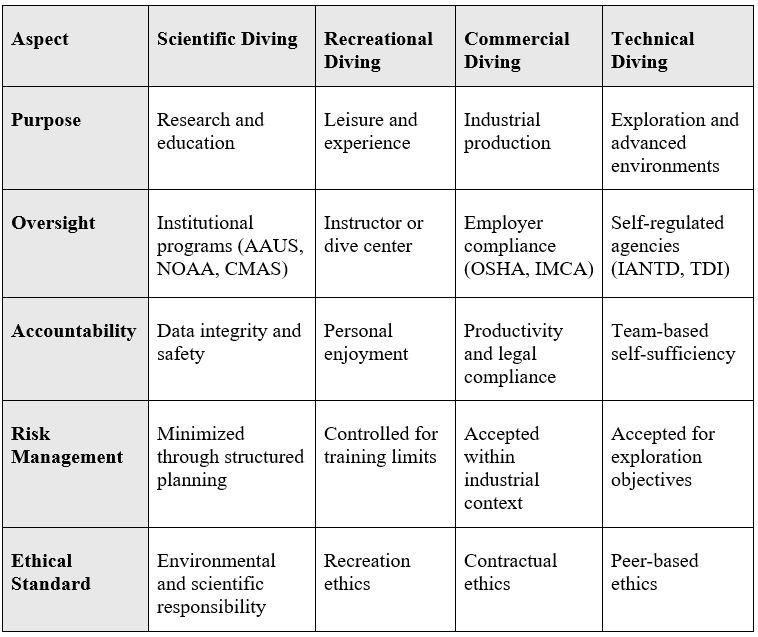
The physics of immersion are identical across all forms of diving, yet motivations and oversight differ significantly.
The Latin American Context
Latin America contains some of the richest aquatic ecosystems on the planet yet historically has lacked formal frameworks for scientific diving. Many researchers have relied on recreational certifications that do not include institutional oversight or research-based safety requirements.
Collaboration has begun to close that gap. The Federación Colombiana de Actividades Subacuáticas (FEDECAS), working with CMAS, created a modular training program that combines international safety standards with scientific methodology and environmental management tailored to local conditions.
Edgardo Ochoa and colleagues expanded that foundation through Buceo científico: Procedimientos y metodologías, which links AAUS and CMAS standards to Latin-American research realities. The text outlines planning, sampling, and ethical procedures that align with global best practices while addressing regional challenges such as limited infrastructure and tropical ecosystem variability. Together, these initiatives form the basis of a growing scientific diving community in Latin America, capable of producing high-quality research under safe and ethical conditions.
Applications to Wilderness and Expedition Medicine
The operational culture of scientific diving parallels wilderness and expedition medicine. Both rely on structured risk assessment, multidisciplinary teamwork, and preparedness in resource-limited settings.
Scientific diving programs require pre-dive medical screening, continuous health monitoring, and post-dive evaluations for decompression stress or thermal exposure. These procedures mirror occupational health systems used in remote expeditions. Divers often work far from definitive care, where prevention and early recognition of problems are vital.
Training overlaps as well. Expedition medics and scientific divers learn to plan logistics, manage fatigue, and respond to environmental stressors. Both disciplines teach that safety depends on collective awareness and clear communication. For professionals in wilderness medicine, the organizational discipline of scientific diving offers a model for conducting complex fieldwork safely and efficiently.
Conclusion
Scientific diving is defined by purpose and process, not by technology or depth. It combines rigorous scientific method with professional diving practice under institutional oversight. There is often more overlap than the formal categories imply, since commercial and research divers may rely on technical systems to reach certain environments, and the environmental ethics central to scientific diving can apply across all forms of professional and technical diving. Scientific divers act as intermediaries between the underwater environment and the data that guide research and conservation.
Scientific diving reflects the same principles that guide wilderness medicine: preparation, ethics, and respect for the environment. Whether operating in polar seas or tropical reefs, every research dive carries both scientific purpose and moral responsibility.