This past February, the WMS completed another successful expeditionary student elective in the hills of the Appalachian Mountains. The educational endeavor, which takes part in areas of Virginia, West Virginia, and North Carolina, thrusts participants into real-world simulations and hands-on didactics that aim to teach via experience. The following excerpts are reflections on the four-week-long adventure from two of the explorers.
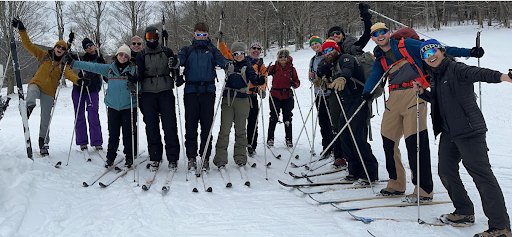
Cross country skiing at White Grass. (Tatiana Lim)
"Challenge by choice. Learn by doing."
These two phrases were echoed throughout my time on the 4-week Wilderness Medicine Student Elective.
As a PA student, my days are usually predictable. I’ve become accustomed to long lecture days, the constant hum of fluorescent hospital lights, and scrubs as my daily uniform. If I’m lucky, I might catch a moment of sunshine on my way in or out of the hospital. But this rotation? This was different.
Instead of hospital hallways, I found myself in the backcountry. My scrubs were swapped for hiking pants and warm boots. Each day was packed with hands-on learning and patient simulations in real outdoor settings – far beyond the familiar comfort of classrooms and textbooks. By the end of the first week, I was amazed at how much could be accomplished with quick thinking and improvisation. Who knew a few hiking poles and jackets could become a makeshift litter? Or that a small branch could work as a windlass for a t-shirt tourniquet? Or that you can carve into an EpiPen for 2-3 additional doses?
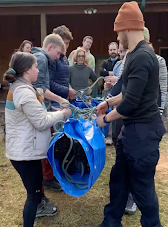
Learning improvised litters and carries. (Tatiana Lim)
This rotation was full of firsts for me. I had never gone scuba diving, never explored a cave, never sailed a boat, and never climbed a cliffside. Coming from sunny California, I had certainly never experienced a true “snow day.” Every activity was “challenge by choice,” and while some activities pushed me out of my comfort zone, I felt reassured knowing we were guided by experts with years of experience. But what made this experience truly unique was how seamlessly medicine was woven into every adventure. Learning to scuba dive was thrilling, but it was even more fascinating to learn how to recognize and treat decompression sickness—insights that felt even more relevant when I realized the Divers Alert Network is based right in my current city of Durham, North Carolina.
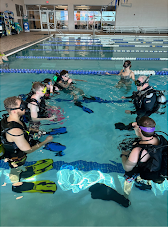
Scuba diving lessons (Tatiana Lim)
Then there was the snow. There was something so special about standing in 6+ inches of fresh snow with sleet stinging our faces all while learning about avalanche rescue and hypothermia. What better way to understand the urgency of creating a hypothermia wrap than trying to make one while shivering yourself? This rotation didn’t just teach us medicine—it taught us how to think, adapt, and act under the same extreme conditions our patients might face.
Hypothermia patient simulations. (Stephanie Reyes Soto)
This elective was all about opportunity, and none of it would have been possible without the passion and dedication of our instructors. Thank you to them for donating their time (including hard-earned days off) and often their own equipment to teach us lessons we could have never learned within hospital walls. Wilderness medicine is a small community, and it only grows through opportunities like this. I’m just incredibly grateful to have been part of it.
-Tati Lim
Something Beautiful Every Day
If you tried to get a hold of me during February 2025, I could not be reached (sorry, mom!). A combination of no cell service and having the time of my life made that a reality. During the month of February, I had the opportunity to participate in the Appalachian Student Wilderness Elective. When asked to describe this elective in one word, I chose the word “wild.” According to Merriam-Webster, there are 10 unique definitions of the word “wild.” For this reflection, I will focus on three:
1. “Going beyond normal or conventional bounds”
Many people think the practice of medicine is structured, clean, and algorithmic. Those reading this article may know that the reality of medical practice is much different. Medicine requires creativity, grit, and perseverance. It is rarely a “clean” delivery, and although it can be algorithmic, it is more often innovative, challenging, and resourceful. My experience at the Appalachian Student Wilderness Elective was enchanting, to say the least. We pushed the norms of “conventional bounds” and found ways to care for ourselves and others using only what we had in our packs. We sheltered together in bunk beds and tents made of plastic bags. We started fires using just pine branches and a knife. Foregoing the instruction manual of the EpiPen, we used our pocketknives to access additional epinephrine doses. We used pen casings, along with CamelBak tubing, to simulate a field cricothyrotomy. While learning orienteering, we ran circles around each other in the rain using compasses and cartoon maps. We laughed, snuggled dogs, ate good food, and challenged our minds. None of this was “normal” or “conventional” for a medical school elective, and that’s what made it so remarkable.
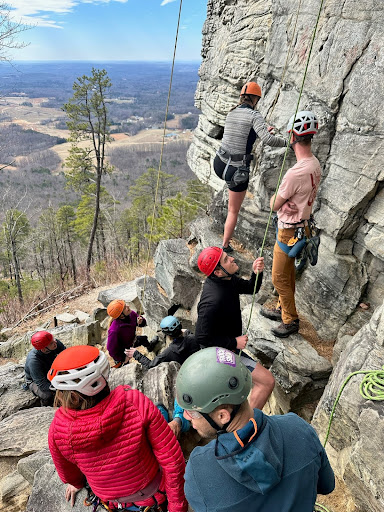
Rock climbing at Pilot Mountain (Tatiana Lim)
2. “Indicative of strong passion, desire, or emotion”
I love medicine. I love it even more after discovering that the limits of where you can be a provider are not as defined or constrained as I previously thought. You do not need to be in a trauma bay to resuscitate a patient. You do not need a CT scanner to diagnose surgical pathologies. You do not need an ambulance or a helicopter to rescue someone. All you need is a passion for medicine, a desire to serve others, and a creative soul in order to use your resources wisely. Add some “excellent training” into the mix, and you have the perfect recipe for being a phenomenal provider. I believe that for this elective, passion is what brought us all to the same place at the same time. Fate ultimately brought ten students, all traveling from different corners of the world, together to learn more about a shared passion. We had many differences—where we came from, our level of clinical experience, our personal backgrounds. Yet what we had in common was more important than any of our distinctions. We all shared an eagerness to learn, a passion for servitude, and a love for the outdoors. Guided by instructors that were intrepid, patient, and brilliant, there was no corner of the Earth that we couldn’t touch.
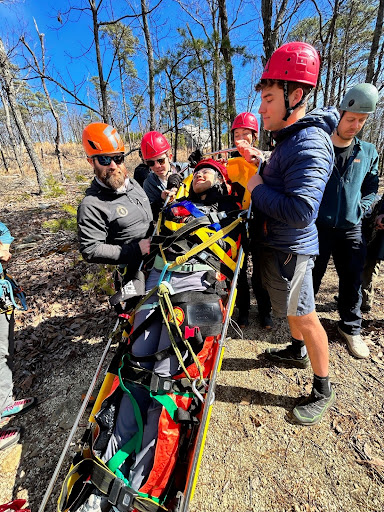
Low-angle rescue simulation day (Stephanie Reyes Soto)
3. “Characteristic of, appropriate to, or expressive of wilderness, wildlife”
There is nothing wilder than an underground cave that appears inconspicuous from the outside but looks like the surface of Mars on the inside. We climbed through slivers and cracks of mud, all while laughing and smiling. We played in the woods, had snowball fights, and hiked on the Appalachian Trail. We braved blizzard conditions in West Virginia and skied at White Grass. We climbed Pilot Mountain and rappelled off the side of a vertical rock ledge. We sailed on a windy day. We carried litters in intense conditions, on dangerous terrain, and we wrapped our friends in insulation burritos to treat hypothermia. We even fought off swarms of stink bugs. I have never felt more cold, more hot, more uncomfortable, more scared—yet more safe, more daring, more bold, more proud, and more free-spirited than I did during this month of adventure. We experienced something beautiful every day and got to do it together. Outside of the settings and breathtaking locations, the beauty also came from our challenges, our resilience, our guidance, and ultimately, our growth.
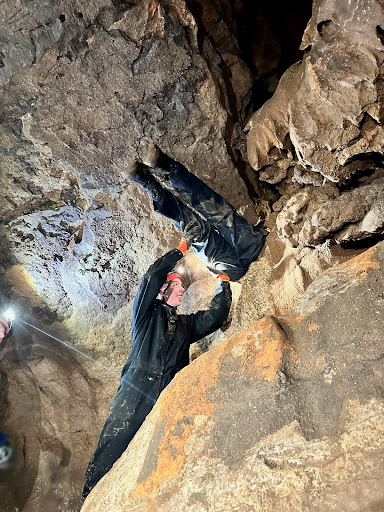
Caving in Blacksburg, VA (Tatiana Lim)
I am grateful that this elective exists because I learned things I never could have learned in a traditional medical school rotation. I was pushed both academically and personally. I learned how to mitigate risks and perform “unsafe activities in a safe way.” I overcame fears and pushed the limits of what I previously thought I was capable of. I made lifelong friends and realized that everyone on my team has a wealth of knowledge and wisdom to share. I became a leader, a provider, and an adventurer. All in all, I learned that “slow is smooth, and smooth is fast,” “if you fail to plan, you plan to fail,” “the best helmet/lifejacket/water filtration system is the one you’ve got,” and that “the juice is 1000% worth the squeeze.”
-Katie Cernkovic, MD