
Approximately 81.6 million individuals live at high altitudes and millions of others visit high altitude destinations. High altitudes introduce distinct environmental stressors. Discussion surrounding the risk of acute mountain sickness, high altitude pulmonary edema, and high-altitude cerebral edema for unacclimatized lowlanders ascending to altitudes above 2500 meters is common. However, individuals often overlook the effects of high-altitude stressors on the skin.
The skin is the largest organ in the human body, acting as a protective layer to prevent infections. In addition to its ability to protect, it also senses and produces vitamin D for the body. In an austere environment, individuals must consider the effects of low humidity, high exposure to UV light, increased wind, cold temperatures, and low oxygen on the skin.
The skin’s protective layer comprises three main layers. The outermost layer is the epidermis, which produces new skin cells and serves as a waterproof barrier for the skin. The middle layer is the dermis, containing blood vessels, nerves, sensory receptors, hair follicles, sweat glands, and sebaceous glands. The innermost layer is the hypodermis, also known as the subcutaneous layer, which contains fat cells to cushion and insulate the skin and connect the skin to the fascia of muscles and bones.
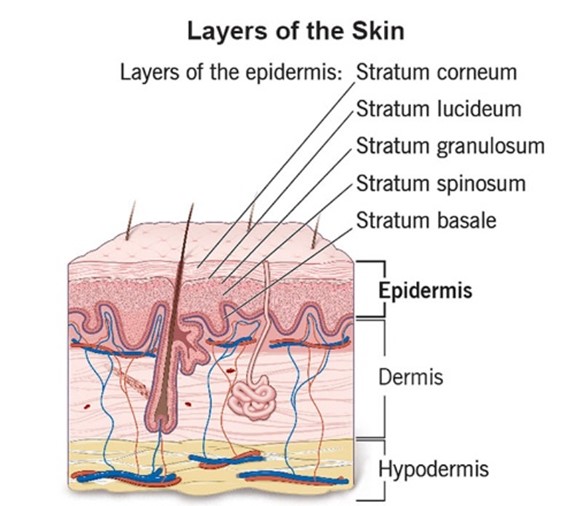
Source: Cleveland Clinic
The epidermis layer is split into the stratum corneum, stratum lucidum, stratum granulosum, stratum spinosum, and stratum basale. When considering the mechanical and bacterial breakdown of the skin at high altitudes, these effects most often cause immediate damage to the epidermis. This breakdown may, in turn, lead to a damaged skin barrier.
The stratum corneum contains a lipid matrix barrier made up of cholesterol, free fatty acids, and ceramides, which are acidic and form the “bricks and mortar” of the skin barrier. Without a normal skin barrier, allergens, microbes, and toxins may cause irritation leading to sensitive skin, allergic dermatitis, rosacea, and many other issues.
Moisturizers play a substantial role in the appearance and maintenance of the skin barrier when exposed to harsh climates. Emollients, humectants, and occlusive agents make up the classification of moisturizers. Emollients act as a filler when the skin barrier is disrupted by filling in the gaps of the brick and mortar makeup of the skin, leading to an improved barrier. An ideal moisturizer should restore the lipid barrier, be non-sensitizing, hypoallergenic, noncomedogenic, fragrance-free, and provide immediate relief and long-lasting hydration to reduce the number of necessary applications. Individuals should utilize moisturizers that contain lipids such as ceramides or squalane and functional ingredients such as aloe vera, glycerol, hyaluronic acid, and niacinamide to decrease transdermal water loss, restore, and maintain the skin barrier.
Humectants work to attract water and moisture from the epidermis and environment to hydrate the stratus corneum, and occlusive agents form an inactive hydrophobic film over the skin to trap the water in the skin. Humectants include active ingredients such as propylene glycol, glycerin, urea, and panthenol. In addition to moisturizers and humectants, occlusives work to form an inactive hydrophobic film over the skin to trap water in the skin. This barrier acts as a sealant, decreases the amount of trans-epidermal water loss, and locks in the moisturizer. Petroleum, petrolatum, mineral oil, and beeswax are examples of active ingredients that act as an occlusive agent.
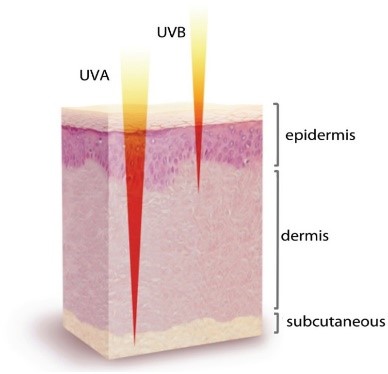
Source: The Surgeon General's Call to Action to Prevent Skin Cancer
When considering the effects of UV radiation, all three layers of the skin become affected. Two types of UV rays require protection. UVB rays cause sunburn and are known to play a role in development of skin cancer and acute skin damage. UVA rays cause skin damage leading to tanning, skin aging, and wrinkles. To protect the skin from the effects of UV rays, sun preventative measures are considered first line. One of the first steps towards prevention involves clothing. Wearing a large brim hat and full sleeved clothing can be the most effective. Ultraviolet protection factor (UPF) is a rating system that indicates how much UV radiation a fabric allows to reach the skin. For example, a fabric with UPF 50 blocks approximately 98% of the sun’s UVA and UVB rays. Clothing must have a UPF value of at least 30 to qualify as the Skin Cancer Foundation seal of recommendation.
In addition to clothing, sunscreen is a crucial tool in protecting the skin from solar energy. By understanding and utilizing sun protection factor (SPF), individuals can take proactive steps to prevent sunburn and skin damage when used as directed. SPF measures the amount of UV radiation required to produce a sunburn in the presence of sunscreen. Contrary to popular belief, SPF is related to the amount of solar exposure rather than time spent in the sun. For example, SPF 30 blocks 97% of UVB, and SPF 50 blocks 98% of UVB rays. Although solar energy is commonly related to solar exposure time, the common misconception regarding the time of solar exposure fails to acknowledge the solar intensity differences during the day, geographic location, altitude, and skin type. As altitude increases, UVA and UVB exposure may increase as much as 30% for every 1000 meters ascended, due to decreased atmosphere filtering of the ozone layer. Environmental factors such as reflective snow, sand, and water may also increase the amount of UV exposure. Since various factors impact the amount of solar radiation an individual receives protection from with SPF, there is no direct correlation between the time spent in the sun.
In addition to the term SPF, sunscreens may also rate the level of UVA protection using the term PA which stands for the protection grade of UVA rays. This type of grading measures how well a sunscreen product protects the skin from UVA rays. Sunscreens, described as broad spectrum, provide UVA and UVB rays coverage.
There are two types of sunscreens on the market. Physical sunscreens, or sunblock, contain titanium dioxide, zinc oxide, or a combination of the two, creating a barrier between the skin and the UV rays. On the other hand, chemical sunscreens, which may include active ingredients such as octisalate, homosalate, octocrylene, octinoxate, oxybenzone, and avobenzone, work by absorbing the rays and changing their chemical structure to reduce damage. Some sunscreens may be considered a hybrid and contain physical and chemical active ingredients.
Underapplication and failure to reapply as directed on the packaging are some of the main reasons sunscreens fail. The reapplication of sunscreen should occur 30 minutes before sun exposure and reapplied every two hours. Sunscreens labeled as water-resistant are effective for 40 minutes, and very water-resistant sunscreen is effective for up to 80 minutes of swimming and sweating. Dermatologists recommend using a sunscreen with a SPF rating of at least 30. Adults typically need about 1 ounce of sunscreen, or enough to fill a shot glass, to cover their entire body.
When deciding what sunscreen to purchase, it is recommended to avoid products that combine sunscreen with mosquito repellent. Sunscreen is often applied more often, leading to more significant amounts of repellent than needed. Sunscreen should be put on first, followed by the repellent. The effectiveness of sunscreen may decrease to one-third when DEET is applied over sunscreen. Individuals should wait at least 10 minutes for the sunscreen to absorb and allow it to provide complete UV protection before repellent application.
Clothing, moisturizers, and sunscreens are crucial in protecting the skin from UV radiation and the harsh elements found at high altitude levels in the austere environment. By using these preventative agents, adventurers can protect themselves from the long-term consequences of inadequate protection from UV radiation and the harsh elements. It is vital to assess and optimize routine care of the skin in the wilderness.