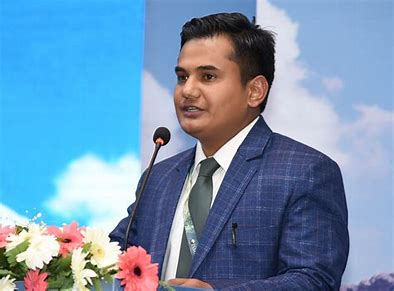
Dr. Santosh Baniya
2024 WMS Conference Student Ambassador, Mykaila Peters interviews one of this summer conference’s featured speakers, Dr. Santosh Baniya. The following article is a transcription of their conversation and has been edited for length.
Dr. Santosh Baniya, MD is a mountain and travel medicine expert, emergency physician and a researcher. Referred to as “The Expedition Doc”, Dr. Baniya partakes in several trekking expeditions in the Himalayas to provide medical care and educational promotion of altitude illnesses for local and foreign travelers. He currently works as an Assistant Professor in the Department of General Practice and Emergency Medicine in Pokhara Academy of Health Sciences. Dr. Baniya is also involved in the Mountain Medicine Society of Nepal (MMSN) and the Himalayan Rescue Association (HRA). He is a managing editor for the Medical Journal of Pokhara Academy of Health Sciences (PoAHS), vice president of the International Society for Mountain Medicine, and vice president of the Mountain Medicine Society of Nepal. His research interests include mountain medicine, high altitude physiology and emergency medicine.
Mykaila Peters (MP): How have events such as the Mustang Trail Race and other expeditions provided opportunities to enhance high altitude education?
Santosh Baniya (SB): When I am out in the expedition I am all by myself from the start to finish, from pre-travel preparation to getting the clients back home safe. Expeditions became the battle field where I was using my knowledge gained from books, training, and courses to identify and treat several health issues. I would be dealing with a wide range of presentations of altitude illnesses (AMS, HACE and HAPE) and all sorts of health issues in real time in expeditions. All of these scenarios provided me with the opportunity to learn about the disease process, human body’s response, and course of illness. In addition, I was also learning about other very important skills like leadership, team work, importance of good communication skills and improvisation. In addition, my interest in high altitude physiology and research also started from these expeditions as I had more time to think and learn about various aspects of high altitude medicine.
Lastly, it was the expeditions from where I realized how to recognize and deal with subtle signs of severe forms of illness and to never ignore risk factors like dehydration, over-exertion, rapid ascent, etc. For example, I realized how important “fatigue” or “someone not wanting to carry his own daypack” are. It can be easily ignored but I have learnt to keep it as an important early sign of HAPE and I never ignore anyone with this symptom and keep a close eye on him/her.
MP: What have been your fondest expedition medicine experiences and why?
SB: My fondest memory is, unfortunately, a case of misery of another suffering. I was in a Gokyo Valley at an elevation of 4,050 meters leading a team of young students (17-19 years) along with their teachers from Hong Kong. We had a great dinner, evening briefing then everyone went to bed. I got a call around 10:00 pm for a guy who was coughing and feeling short of breath while lying down. I attended to him and found out that he had developed HAPE. We started the oxygen (which was leaking and not enough) and the decision to descend was made immediately. We made a team of 4 (guide, porters and me) and started to descend in the middle of the night with a torch light, mobile phone light and water. We carried the boy in the back turn by turn and descended around 400 meters taking approximately 4 hours. The boy rested for 2-3 hours in a tea house under my observation and he was evacuated in the helicopter next morning and returned home safely.
In regards to the event it would be the Mansalu Trail Race in 2017. It was a multi-stage trail running in high altitude. I was taking charge of 56 runners and 24 support staff in the event. I was absolutely immersed in taking care of the entire team. I was running here and there every day and was dealing with all sorts of problems ranging from trauma, altitude illness, diarrhea, emotional problems and so on. I loved the varieties of cases I was dealing with and making a difference in everyone’s life.
MP: What is your method for contingency planning for your expeditions overall? How does this vary when planning for levels of difficulty ranging from 1-4?
SB: Planning begins before the expedition starts.
· Firstly, I do thorough workup on the expedition location. I do in-depth analysis of terrain, weather, topography and geographical complications.
· Then, I go through the health records of each client. I ask all the clients to read and sign a declaration medical form which includes past medical history, past history of altitude exposure, details of current medication, history of allergies, and then customize the medical kit accordingly.
· Research is done to identify nearby health facilities. If available, I never miss a chance to visit and talk to the health care provider about our expedition and make plans for possible help/collaboration that might be required during the expedition.
· I never miss a chance to talk to the local experts with previous experience.
· Lastly, I always make sure that all the team members are properly insured (i.e., helicopter evacuation insurance in Nepal).
In case of any emergency, I combine these with available resources to make the best out of the situation.
Yes, this varies based on the level of difficulty. As the level of difficulty increases (1-4), the level of preparation also increases because we have less access to human civilization as well as difficult terrain, higher altitude, and more technical conditions with the majority of time being all on our own.
MP: What are future research topics that you are interested in investigating? What do you envision lies ahead in the realm of high altitude research and medicine?
SB: I am interested in studying the hematological response of lowlanders and highlanders in longitudinal design. In addition, I am interested in revisiting the incidence/prevalence of altitude illness currently and would like to investigate the autopsy findings of deaths in high altitude.
A lot of great minds have been working in investigating multiple domains of high altitude physiology, pathophysiology, treatment of high altitude illnesses, genetics in high altitude, use of AI in predicting high altitude illnesses and so on. I believe science has a lot to offer in the future in high altitude medicine. Probably, newer discoveries in predicting chances of altitude illness (use of AI, biochemical basis), more insight into genetics in all types of highlanders, treatment of high altitude cough and so many more are waiting for us in near future.
MP: Your research on the “impact of traveling to high altitude in the Himalayas on self-reported appetite” concluded that appetite is reduced while satiety is increased with higher altitude. What do you recommend for people who experience a loss of appetite at altitude to ensure they obtain adequate caloric intake? What are your favorite things to eat at altitude?
SB: The basal metabolic rate can double from baseline during expeditions, so it is very important to focus on total calorie intake. Adjustments can be made to fulfill the calories required for the body to perform well at altitude. Shifting from regular meals to high-calorie foods with a proper plan for the day can be valuable.
For example:
· Breakfast: Granola with dried fruits, milk, eggs.
· Lunch: Soup, Fish, meat, cheese, beans.
· Snacks: Fruits (Apple, oranges), chocolate bars, gels.
· Dinner: Soup, pasta/noodle with meat sauce, plain rice/bread, dried fruits.
My favorite things to eat at altitude are:
· Breakfast: Eggs, Tibetan bread/Chappati with curry or noodle soup
· Lunch: MoMos or Pasta with meat sauce or Thukpa (noodle soup with mixed veggies with meat and eggs)
· Snacks: Nuts (Cashew nut, pista, peanuts), Granola with dried fruits, fruits (banana or apple)
· Dinner: Nepali Dal-Bhat (Steamed rice with curry with lentil soup)
MP: What have you learned about yourself throughout your years of embarking on expeditions and how has this influenced how you practice medicine?
SB: Firstly, expeditions have always made me realize how much love I have for the mountains and the entire environment in high altitude.
Secondly, I always enjoyed working in challenging scenarios. That was one of the reasons I went into emergency medicine and mountain medicine. It didn’t take much time for me to realize that I was thriving in these challenging scenarios. In addition, I also learned that I could work with a team, work in harsh environments with limited resources, take leadership and make decisions in difficult situations.
Expeditions have had a large influence on my day-to-day clinical practice. Medical practice in the wilderness requires greater dependency on using clinical skills and observation. We don’t have the luxuries of performing labs, scans, etc. And, this has directly affected my daily clinical practice where I am more attentive to patients’ complaints, do through clinical exams, and only do the required tests and scans to help patients.
Lastly, the leadership skills, communication skills, and decision-making in difficult scenarios learned from the wilderness has direct influence in my daily clinical practice.